How AI Content Is Detected: Top Patterns, Words, and Writing Signals to Avoid
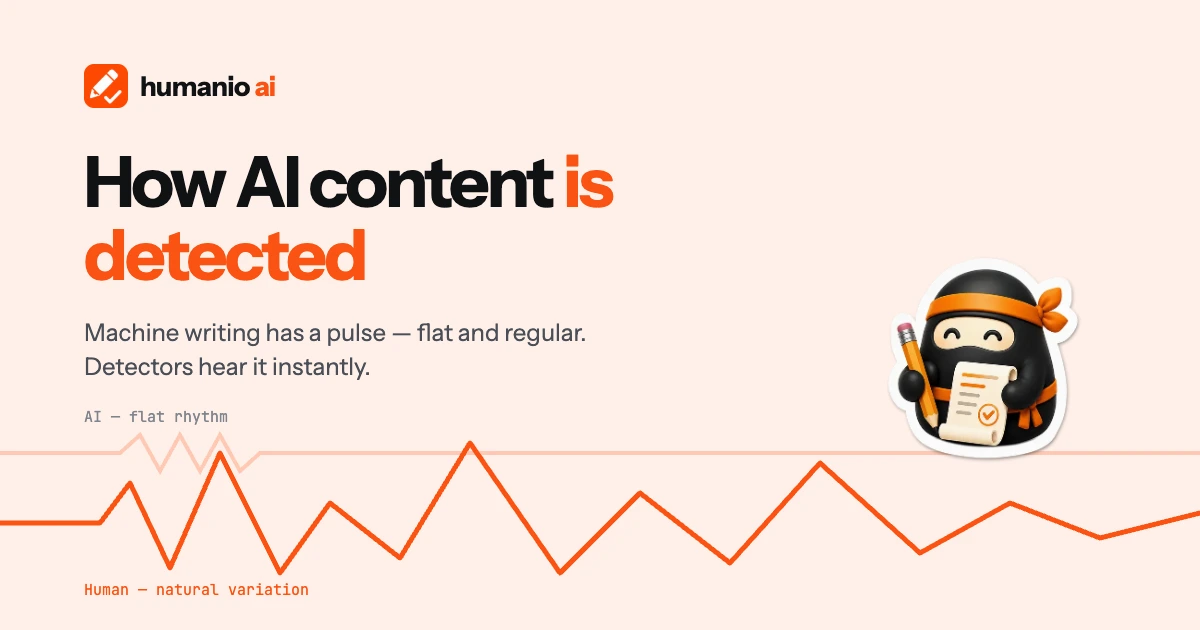
AI writing tools have become incredibly good at producing articles, emails, essays, and marketing copy. But despite their improvements, AI-generated text often leaves behind recognizable patterns that detection tools can identify.
Contrary to popular belief, AI detectors don’t simply search for specific words like «delve» or «leverage.» Instead, they analyze hundreds of writing characteristics, including sentence structure, vocabulary diversity, repetition, and overall writing style.
Understanding these signals can help you edit AI-generated content into something that sounds more natural, engaging, and authentically human.
What Is AI-Generated Content?
AI-generated content is text created fully or partially with a generative AI model such as ChatGPT, Claude, or Gemini. It can include articles, essays, emails, product descriptions, social media posts, and other types of writing. While AI content can read naturally, it often contains recurring language and structural patterns that make it different from typical human writing.
How Is AI-Generated Content Detected?
Modern AI detectors don’t know whether a human or AI actually wrote a piece of content. Instead, they estimate the probability that text was generated by a language model.
Most detectors analyze factors such as:
- Sentence variation
- Word predictability
- Vocabulary diversity
- Paragraph structure
- Repeated language patterns
- Overall writing rhythm
Rather than relying on one clue, detectors combine dozens of small signals to make a prediction.
This is why simply replacing a few «AI words» rarely changes the detection result.
10 Common AI Writing Patterns Detectors Look For
AI writing patterns are recurring characteristics in vocabulary, sentence structure, rhythm, formatting, and organization that appear frequently in machine-generated text. No single pattern proves that content was written by AI, but several appearing together can make AI-generated writing easier for detection systems to identify.
1. Uniform Sentence Length
One of the strongest indicators of AI writing is extremely consistent sentence length.
Large language models naturally produce paragraphs where nearly every sentence contains a similar number of words.
AI Example
Artificial intelligence is transforming modern businesses by improving efficiency and enabling organizations to automate repetitive tasks. Companies increasingly adopt AI technologies to reduce operational costs and improve customer experiences. Businesses continue investing in AI because it provides valuable insights and increases productivity.
Notice how every sentence feels almost identical in length and rhythm.
Human Version
Artificial intelligence is changing how businesses operate. Some companies use it to automate repetitive work, while others rely on it for customer support or data analysis. The benefits are real, but success depends on how well the technology fits existing workflows.
The second example mixes short and long sentences, creating a much more natural flow.
2. Predictable Paragraph Structure
AI frequently organizes paragraphs using the same pattern:
- Introduce a claim.
- Explain the claim.
- Summarize the point.
Repeated dozens of times, articles begin to feel mechanical.
AI Example
Email marketing is important for businesses. It allows companies to communicate with customers efficiently. Therefore, businesses should include email marketing in their overall strategy.
Better Alternative
Email marketing remains one of the highest-converting digital channels. A welcome email can generate more engagement than many paid ads because subscribers have already shown interest. That’s why many businesses continue investing in email campaigns even as social media evolves.
Instead of following a rigid template, the paragraph introduces evidence naturally.
3. Repetitive Transition Words
AI models love transitions.
You’ll often see:
- Furthermore
- Moreover
- Additionally
- Consequently
- Therefore
- In conclusion
Using them occasionally is perfectly fine.
Using them in almost every paragraph creates a repetitive writing style.
AI Example
Furthermore, businesses should invest in SEO.
Additionally, content marketing improves visibility.
Moreover, social media increases engagement.
Better Version
Businesses should also invest in SEO.
Content marketing helps attract long-term traffic.
Social media keeps customers engaged between purchases.
Natural writing doesn’t require every paragraph to begin with a formal transition.
4. Generic Opening Phrases
AI frequently starts sentences with phrases that add little meaning.
Common examples include:
- In today’s world…
- It is important to note…
- It is worth mentioning…
- At the end of the day…
- There is no doubt that…
These phrases increase word count without adding useful information.
AI Example
In today’s digital world, it is important to note that cybersecurity is becoming increasingly important.
Better Version
Cybersecurity has become a priority for businesses of every size.
Same message. Half the words. Much stronger writing.
5. Overused AI Buzzwords
Some words appear far more often in AI-generated content than in everyday writing.
Examples include:
- Delve
- Leverage
- Utilize
- Facilitate
- Optimize
- Streamline
- Enhance
- Robust
- Comprehensive
- Seamless
These words aren’t wrong.
They’re simply overused.
AI Example
Businesses should leverage AI to optimize workflows and facilitate seamless collaboration.
Human Version
Businesses can use AI to simplify daily tasks and help teams work together more efficiently.
The second sentence feels much more conversational.
6. Low Vocabulary Diversity
AI often repeats the same keywords multiple times because it’s optimized for topical relevance.
AI Example
Content marketing improves content visibility because content helps businesses create better content strategies.
While technically correct, repeating the same word four times feels unnatural.
Better Version
Publishing useful articles helps businesses improve search visibility, attract new readers, and build long-term authority.
The meaning stays the same while the vocabulary becomes more varied.
7. Too Much Filler
AI likes adding words that don’t contribute much.
Examples include:
- It can be said that…
- There is no doubt that…
- It is clear that…
- It should be noted that…
- A wide range of…
- Plays a significant role…
AI Example
Artificial intelligence plays a significant role in helping businesses improve productivity.
Better Version
Artificial intelligence helps businesses work more efficiently.
Shorter. Clearer. More natural.
8. Excessive Hedging
AI often avoids making direct statements.
Instead, it uses words like:
- may
- might
- generally
- often
- typically
- can
- potentially
AI Example
AI can potentially help businesses improve customer satisfaction in many situations.
Better Version
AI helps many businesses respond to customer questions faster through automated support systems.
Specific examples sound more credible than vague possibilities.
9. Overly Perfect Formatting
Human writers naturally vary how they organize content.
AI often produces articles where every section looks identical:
- Heading
- Intro sentence
- Three bullet points
- Closing sentence
Repeated throughout the article, the structure becomes highly predictable.
Instead, mix formats by using:
- Examples
- Short paragraphs
- Stories
- Tables
- Quotes
- Numbered steps
- Screenshots
Natural variation makes content more engaging.
10. Lack of Original Insight
Perhaps the biggest giveaway isn’t grammar—it’s originality.
AI usually summarizes existing knowledge.
Human writers explain ideas using:
- Personal experience
- Real case studies
- Original opinions
- Industry observations
- Practical advice
AI Example
SEO helps improve website rankings.
Human Version
After updating over 200 blog posts, we found that rewriting introductions and improving internal links consistently increased organic traffic within three months.
Real experiences create unique content that AI rarely produces on its own.
Common AI Words and Language Patterns to Watch For
Certain words, phrases, and transitions appear frequently in AI-generated writing. They are not proof that a text was written by AI, and human writers use them too. The signal becomes more noticeable when the same vocabulary appears repeatedly alongside other common AI writing patterns.
- Delve
- Leverage
- Utilize
- Facilitate
- Optimize
- Streamline
- Enhance
- Comprehensive
- Robust
- Landscape
- Realm
- Arena
- Crucial
- Essential
- Vital
- It’s important to note
- It’s worth noting
- To summarize
- Finally
Using these words occasionally is perfectly normal.
Problems arise when many of them appear repeatedly throughout the same article.
Can You Fool AI Detectors by Replacing Words?
Not usually.
Modern AI detectors evaluate writing patterns, not just vocabulary.
Simply changing «utilize» to «use» or «delve» to «explore» rarely changes the overall detection score if the paragraph still follows the same predictable structure.
Effective humanization requires:
- Rewriting sentences.
- Changing paragraph flow.
- Varying sentence rhythm.
- Adding specific examples.
- Removing repetitive transitions.
- Including original insights.
Are AI Detectors Always Accurate?
No.
This is an important point.
AI detection tools rely on statistical probabilities—not certainty.
That means they can:
- Flag human-written content as AI.
- Miss heavily edited AI-generated text.
- Produce different scores for the same article across different detection tools.
Because of this, AI detection should be viewed as a helpful estimate rather than definitive proof of authorship.
Quick Checklist Before Publishing
Before publishing AI-assisted content, ask yourself:
- Do my sentences vary in length?
- Have I removed repetitive transition words?
- Did I replace generic phrases with direct language?
- Is there unnecessary filler?
- Does the article include specific examples?
- Have I added my own expertise or opinions?
- Does the writing sound like something I would naturally say?
If you can answer «yes» to these questions, your content will likely read much more like it was written by a real person.
Frequently Asked Questions
What Makes AI Content Detectable?
AI content becomes more detectable when several predictable writing signals appear together. Common examples include uniform sentence length, repetitive paragraph structures, generic transitions, limited vocabulary variation, excessive hedging, highly consistent formatting, and a lack of specific or original insight. AI detectors analyze combinations of these patterns rather than relying on one suspicious word or phrase.
What Are Common AI Patterns in Writing?
Common AI writing patterns include similar sentence lengths, predictable paragraph structures, repetitive transitions, generic opening phrases, recurring vocabulary, excessive hedging, and highly consistent formatting. AI-generated text can also lack the specific experiences, examples, and unexpected phrasing that naturally appear in human writing.
What Patterns Do AI Detectors Look For?
AI detectors can analyze signals such as word predictability, sentence variation, vocabulary diversity, repetition, paragraph structure, and overall writing rhythm. Different detectors use different models and methods, so the same text may receive different results across detection tools.
Final Thoughts
AI-generated content isn’t detected because of one suspicious word or phrase. Instead, detectors analyze the overall writing style, looking for repetitive structures, predictable language, low variation, and generic phrasing.
The best way to make AI-assisted writing feel authentic isn’t by swapping a few words—it’s by thoughtfully editing the content, improving sentence flow, adding original insights, and writing with a natural voice.
When your content reflects real experience and clear communication, it doesn’t just perform better with AI detectors—it also provides a better experience for your readers.
Create More Natural Content with Humanio AI
Editing AI-generated content manually takes time, especially for long articles. Humanio AI helps transform robotic AI drafts into natural, engaging writing by improving sentence variety, removing repetitive patterns, and preserving your original meaning. Whether you’re creating blog posts, academic papers, or marketing content, Humanio AI helps your writing sound authentically human.
👉 Try Humanio AI and turn AI-generated text into content your readers will actually enjoy.