How to Humanize AI Content in Claude: Best Practices for Natural, Undetectable Writing
Claude is widely used for drafting articles, emails, reports, and other long-form content. While its writing is often clear and well-structured, it can still contain predictable AI patterns that make the text sound robotic or generic.
Instead of publishing AI-generated content as-is, it’s better to treat Claude’s output as a first draft. With the right humanization process, you can improve readability, create a more natural writing style, and make the content feel like it was written by a real person.
Why Claude Content Still Needs Humanization
Claude produces high-quality writing, but like most AI models, it often follows recognizable patterns, including:
- Consistent sentence length throughout a paragraph.
- Repetitive transitions and introductory phrases.
- Generic explanations that lack personality.
- Overly polished wording that feels unnatural.
- Predictable paragraph structure.
These characteristics can make otherwise useful content feel less authentic.
Start With Claude’s Best Draft
When using Claude, avoid publishing the first response immediately.
Instead:
- Let Claude finish generating the complete response.
- If you ask for revisions, review the most refined version rather than the initial draft.
- Treat the output as source material that still requires editing.
The final version is usually more coherent, but it still benefits from human review.
Rewrite Instead of Making Small Edits
Simply replacing a few words isn’t enough to humanize AI content.
A stronger approach is to rewrite sentences in your own style while preserving the original meaning.
Focus on:
- Rearranging sentence structure.
- Combining or splitting sentences naturally.
- Using transitions that fit the context.
- Eliminating repetitive phrasing.
Substantial rewriting creates more authentic content than surface-level edits.
Remove AI Writing Patterns
Many AI-generated drafts rely on phrases that appear repeatedly across different topics.
Watch for expressions like:
- «In today’s rapidly evolving world…»
- «It is important to note…»
- «Plays a vital role…»
- «Provides valuable insights…»
- «Furthermore…»
Replace these with direct, specific language that better supports your message.
Clear writing almost always sounds more human than overly formal writing.
Add Personal Perspective
One of the biggest differences between AI-generated and human-written content is original thinking.
After Claude generates a draft, ask yourself:
- Can I add a real example?
- Can I explain this idea differently?
- Can I include an observation or experience?
- Can I make the argument more specific?
Adding your own insights gives the content a voice that AI alone cannot replicate.
Improve Sentence Variety
AI models often produce paragraphs where every sentence has a similar rhythm.
To create more natural writing:
- Mix short and long sentences.
- Use occasional one-sentence paragraphs when appropriate.
- Alternate between detailed explanations and concise statements.
These variations improve readability and reduce repetitive patterns.
Edit for Clarity, Not Complexity
Many writers assume that sophisticated vocabulary makes content better.
In reality, readers usually prefer writing that is:
- Clear.
- Direct.
- Easy to follow.
- Free of unnecessary filler.
If a sentence can be shortened without changing the meaning, shorten it.
Natural writing is often simpler than AI-generated prose.
Review the Entire Article
Before publishing, read the complete article from beginning to end instead of editing individual sentences in isolation.
Look for:
- Repeated wording.
- Similar paragraph openings.
- Awkward transitions.
- Sections that feel overly generic.
A final review helps ensure the article flows naturally and maintains a consistent voice throughout.
Best Practices for Humanizing Claude Content
Use this checklist before publishing:
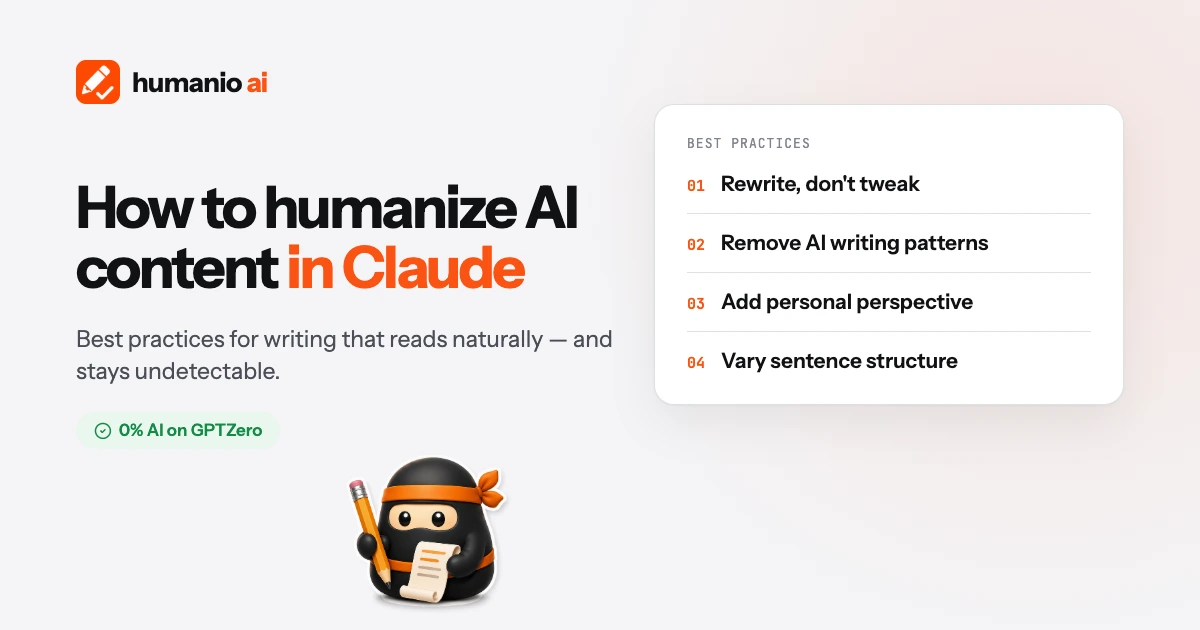
- Rewrite instead of making minor edits.
- Remove repetitive AI phrases.
- Vary sentence length and structure.
- Replace generic statements with specific examples.
- Simplify overly formal language.
- Add your own expertise and perspective.
- Read the content aloud to improve flow.
Final Thoughts
Claude is an excellent writing assistant, but the best results come from thoughtful editing rather than copying its output directly. Humanizing AI-generated content means refining structure, improving clarity, and adding original insights that reflect your own voice.
Whether you’re creating blog posts, marketing copy, or academic content, investing time in careful editing will produce writing that is more engaging, more authentic, and more enjoyable to read.
Humanize Claude Content Faster with Humanio AI
Manually rewriting every AI-generated draft can be time-consuming. Humanio AI helps transform Claude-generated content into natural, human-like writing by improving sentence variety, removing repetitive AI patterns, and preserving your original message. Whether you’re publishing blog posts, business content, or research articles, Humanio AI helps you create writing that feels authentic from start to finish.
👉 Try Humanio AI and turn your AI drafts into naturally human content in minutes.