AI in Academic Writing: What’s Allowed and How to Use It Well
AI belongs in academic writing as a tool that works on your ideas, never one that supplies them. The safest uses are brainstorming, outlining, and polishing sentences you already wrote. The riskiest are generating text from scratch and trusting the citations it produces. Whatever you do, check your instructor’s or journal’s policy first and keep a record of what you used. Our AI humanizer is built for the polishing stage. It rewrites at the sentence level and keeps your meaning, keywords and voice, so a stiff draft reads like you wrote it.
TL;DR
- Use AI most freely on text you already wrote: grammar, clarity, flow and readability. Research on ethical use ranks this as the most acceptable tier.
- Brainstorming, outlining and summarizing are fine when you verify the results. Drafting from scratch is the least defensible use.
- Policies differ by school, department, course and journal. Disclosure rules are getting stricter, so read the one that applies to you and keep a log.
- Never trust AI-generated citations without opening the source. Fabricated references are well documented.
- AI detectors are unreliable and can wrongly flag honest writing, so the best protection is a draft built on your own thinking, with a record of your process.
Table of Contents
- Where AI helps and where it hurts
- What universities and journals actually require
- The risks you can manage
- Can professors tell? What detectors really show
- A workflow that keeps the ideas yours
- Why polishing is where a humanizer fits
- Starting with Humanio
- What is likely to keep changing
- FAQ
- Sources
Where AI helps and where it hurts
The UNC Writing Center lists the uses that hold up best. AI can ask questions about the key words in a prompt, generate outlines you then revise, model an unfamiliar genre such as a literature review or abstract, summarize a long text as a guide before you read the full thing, and suggest sentence-level improvements. Every one of those uses assumes your instructor allows it.
A 2025 peer-reviewed paper by Cheng, Calhoun and Reedy sorts AI uses into tiers:
| Tier | Examples | How to treat it |
|---|---|---|
| Most acceptable | Restructuring your own text for grammar, spelling, readability, translation | Check that edits still sound like you |
| Contingent | Outlining, summarizing, brainstorming | Verify everything a human would verify |
| Least acceptable | Drafting new text from a prompt that contains none of your own content | Avoid |
The logic is simple. These models work best when the ideas are already in your input. Drafting from nothing also skips the deep engagement with sources that makes academic writing worth doing. For a marketer or blogger the stakes are lower, but the pattern is the same: AI improves what you give it and is weakest when it has to invent.
What universities and journals actually require
There is no single U.S. rule. Policy sits at the level of the university, the department, the course and the publisher, and it keeps changing. A few examples show the range.
- Instructor permission first. LSU’s faculty guidelines for 2025-2026 allow AI only when the course instructor has established it. They name brainstorming, summarizing, outlining, explaining content and proofreading as acceptable uses. Failing to disclose use is treated as academic dishonesty.
- Light editing versus real contribution. The University of Washington Graduate School compares AI grammar and editorial help to human proofreading, which generally needs no acknowledgment. Using AI to write part of a paper or dissertation may count as cheating or plagiarism.
- A formal material test. Kennesaw State’s May 2026 guidance separates material contributions (substantive ideas, text beyond surface corrections, analysis) from immaterial ones (spell-checking, grammar, formatting, word swaps that don’t change meaning). Material contributions must be disclosed with the tool name and version, the purpose and scope, and how a human validated the output.
- Journals. APA’s journal policy requires disclosure when generative AI is used to draft a manuscript and does not allow AI to be named as an author. Wiley’s author guidelines say simple grammar correction and word-choice suggestions typically need no disclosure, while AI-generated substantial text or restructured arguments do.
- Stricter departments. The University of Maryland’s psychology department interim policy for 2026 requires first drafts of theses and dissertations to be written by the student without AI assistance, and it asks for model name, version, prompts and the exact AI-attributable portions when AI is used elsewhere.
The pattern: the closer AI gets to producing your argument, the more disclosure and permission you need. Authors are accountable for every word under their name regardless of how it was produced.
Check your own policy before you write
Start with the syllabus, then the department handbook, then the journal’s author guidelines. If you are unsure whether a specific school allows a tool, our university AI policy checker collects policy lookups, including pages for Cornell and Harvard. When a policy is ambiguous, email your instructor and save the reply.
The risks you can manage
Fabricated citations
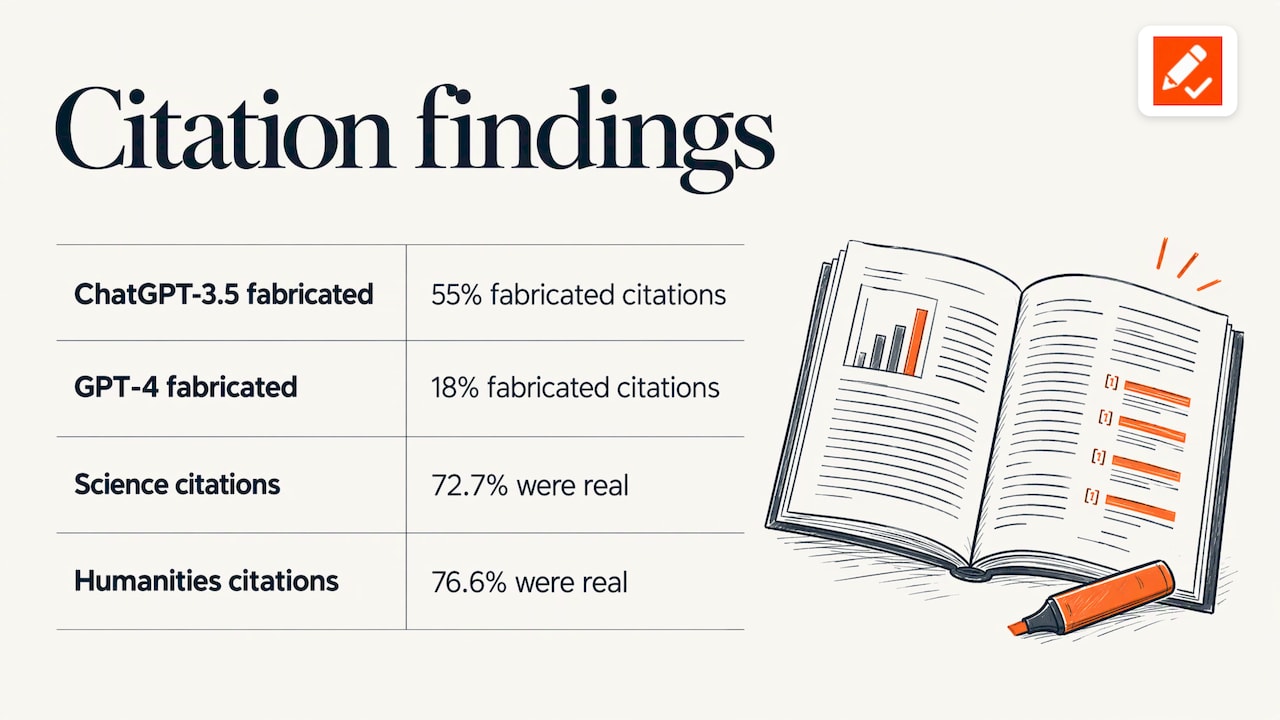
This is the best-documented failure. A 2025 review by Oermann and colleagues reports that in one earlier study, 55% of citations from ChatGPT-3.5 and 18% from GPT-4 were fabricated. In another, only 72.7% of science citations and 76.6% of humanities citations were real.
The APA Style team found the same thing in a small test. Of five sources a chatbot gave on brain lateralization, only four could be located, and the fifth had a real DOI that belonged to a different article. Their advice: read the original sources and paraphrase or quote those, not the model’s interpretation of them.
In practice, every reference gets opened. You confirm the author, year, title and DOI match, then confirm the source says what your sentence claims.
Privacy and training data
Cornell’s writing support office warns that material you enter can be shared, leaked or hacked. It recommends leaving out personal or FERPA-protected information and turning off ChatGPT’s training option before entering proprietary material. Do not paste in a classmate’s work, interview transcripts with names, or unpublished data you don’t own.
Flowery text that isn’t your voice
Cornell also flags output that is flowery and doesn’t sound like you. The research shows it at scale: the Oermann review cites a study of nursing literature in which the word “intricate” rose 435% and “delving” 365% in articles starting in 2023. Readers, editors and instructors notice that register. It is a readability problem before it is an integrity problem.
Authorship
AI cannot be listed as an author, because it cannot approve a final manuscript or be held accountable for accuracy under ICMJE criteria, as the same review explains. You are the author, so you carry the responsibility.
Can professors tell? What detectors really show
Many readers come to this topic worried about detectors, so here is what the evidence supports.
Plagiarism software typically cannot flag AI writing, because AI generates sentence combinations that have not existed before. APA’s overview also reports a study in which novice and experienced teachers struggled to tell AI text from student text while overestimating their own ability. One detector classified 99% of the U.S. Constitution as AI-generated. All of this is in APA’s article on AI in research and writing.
The bigger issue is fairness. A 2023 Stanford study of seven detectors, covered in that same APA piece, found they labeled more than half of 91 essays by non-native English speakers as AI-generated, with an average false-positive rate of 61.3%. Only 5.1% of essays by U.S. eighth graders were misclassified.
What this means for you:
- A detector score is not proof of anything, in either direction.
- Your best evidence of authorship is process: notes, outlines, dated drafts, your source list and a log of any AI use.
- If you do use AI on your own draft, a quick pass with an AI detector shows you which passages read as machine-like, so you can rewrite them in your own words.
That is a revision aid, not a way to settle an integrity question. Policies decide what is allowed, and a score doesn’t change that.
A workflow that keeps the ideas yours
This sequence follows the tiers above and the disclosure rules most schools share.
1. Confirm the rules
Read the syllabus or author guidelines. Note whether disclosure is required, where it goes, and what detail it needs. APA, for example, places different disclosures in different sections depending on whether AI helped with a literature search, copyediting, code or drafting. Decide before you start which uses are permitted.
2. Think and outline first
Write your thesis in a sentence or two before you open any AI tool. If you want help, ask for questions about your topic or a few outline options to compare against your own. UNC suggests treating the output as something to revise and compare, not accept.
3. Read the sources yourself
Use AI summaries only as a map before reading the full text. Quote and paraphrase from the originals. This is also where the fabricated-citation risk lives, so verify each reference as you add it.
4. Write the draft in your own words
Cheng and colleagues recommend asking four questions of your own work: do the primary ideas remain yours, are you maintaining your writing competency, is all content and every reference verified, and is AI use fully disclosed. If any answer is no, fix that before polishing.
5. Polish the draft
This is the stage where AI is on firmest ground. Ask it for a list of issues such as repetition, unclear sentences and passive constructions, as Cornell suggests, then decide which to fix. Or run the draft through a rewriting tool that works on your wording.
Then do what UNC recommends: compare your original side by side with the edited version. Ask whether it got clearer and whether it lost your voice. Reject any edit that changed your claim.
6. Disclose and log
Record the tool name and version, the date, what you used it for, and what you changed. Several of the policies above ask for exactly these fields. Even if your instructor doesn’t require disclosure, the log protects you.
Why polishing is where a humanizer fits
A first draft, especially one that started from an AI outline or a rough machine paraphrase, often has the same flaws: repeated sentence openers, stiff transitions, padded phrases and a uniform rhythm. Swapping synonyms doesn’t fix that, and it can distort meaning in technical writing.
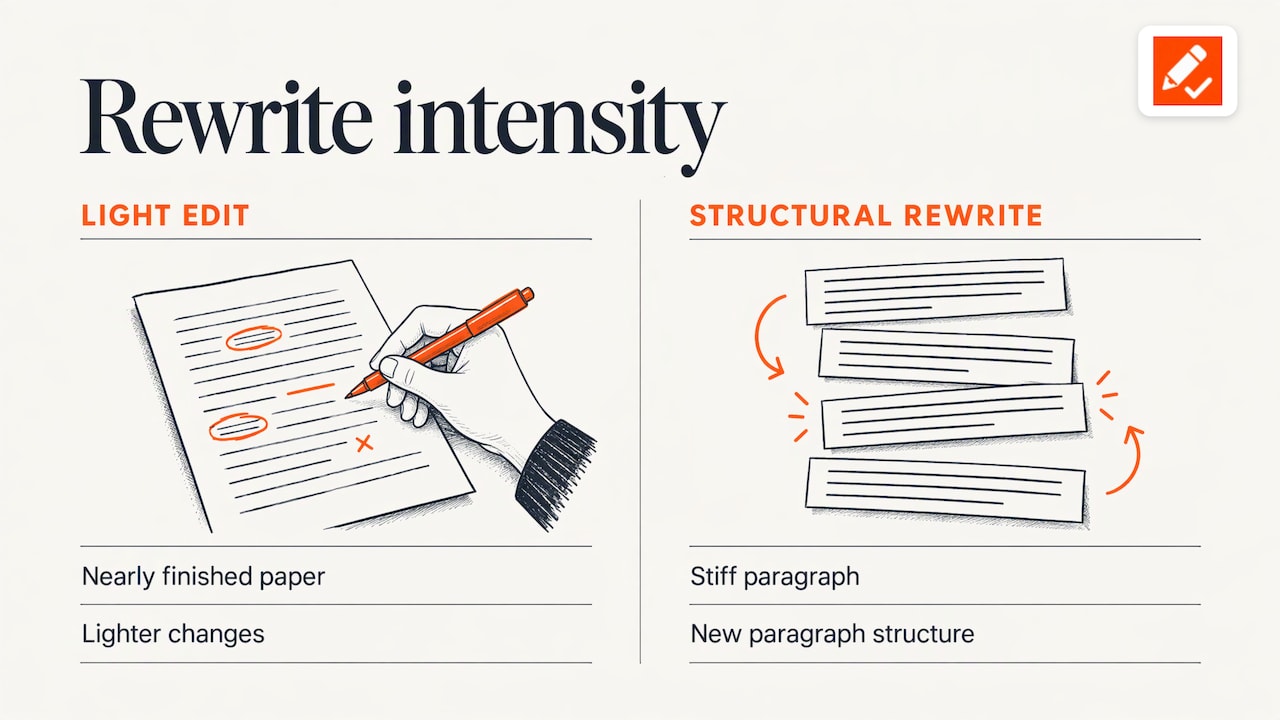
Humanio rewrites at the sentence level rather than swapping words. It is designed to preserve your meaning, your keywords and your voice, and you choose the intensity, from a light edit to a more substantial structural rewrite. Light edits suit a nearly finished paper. A heavier rewrite suits a stiff paragraph that needs new structure. It works on text from different AI models, and it is built for essays, articles, emails and web copy alike.
You can see how this applies to schoolwork on our humanizer for academic writing and essay humanizer pages. For longer scholarly work, our guide on humanizing AI content for a research paper walks through keeping academic quality intact.
One point applies to every use: it should be applied to ideas and wording that are yours, within your institution’s rules. We have tested Humanio against popular detectors including GPTZero, ZeroGPT and Pangram, though results vary with the text and the detector. Disclosure and policy compliance remain with you.
Starting with Humanio
If your draft is complete and needs to sound like you, paste it into the Humanio AI humanizer, pick a light edit first, and compare the result with your original before accepting changes. Paid plans are published on the pricing page: Starter is $6.99 per week, Pro is $9.99 per week and Business is $19.99 per week.
Marketers, bloggers and freelancers can use the same approach on landing pages, posts and client emails, where the goal is readability and a consistent voice. Students and professional writers should add the same final step: confirm that the polished text still says what they meant, and update the AI-use log.
What is likely to keep changing
Policies tightened quickly between 2023 and 2026. Kennesaw State’s 2026 guidance now requires usage logs for audit purposes and spells out the material versus immaterial distinction. A 2024 editorial in the Journal of Management Studies, noted in the same guidance research, moved to require a declaration even for AI copyediting and language proofing, which previously did not need one.
Expect more of that: finer-grained disclosure fields, version numbers, and departmental rules stricter than the university’s. Treat any policy you read as a snapshot, reread it at the start of each term or submission, and keep your own records so that you can answer any question about your process.
FAQ
Is it ethical to use AI in academic writing?
It is when your institution permits the specific use, you disclose it as required, and the ideas and arguments are yours. Editing for clarity sits at the most accepted end of the range, while generating whole sections for you to submit is the least accepted. Authors stay responsible for everything under their name.
Do I have to disclose AI use?
It depends on the school, course or journal. Many treat spell-checking and light grammar fixes as immaterial, but substantive text, restructured arguments or analysis usually need disclosure with the tool name, version and purpose. Some departments ask for more, so check the rule that applies to you and keep a log.
Can professors tell if you used AI to write an essay?
Not reliably. APA reports that teachers struggled to tell AI text from student text, and detectors have produced striking errors, including a 61.3% average false-positive rate on essays by non-native English speakers in a Stanford study. Drafts, notes and a use log are stronger evidence of your authorship than any score.
Which AI is best for academic writing?
The tool matters less than the task. For idea generation and outlining, a general chatbot is enough, and your sources still need checking by hand. For polishing, you want something that works at the sentence level and keeps your meaning and keywords intact, which is what Humanio is designed for. Our guide to the best AI for writing goes deeper on choosing by task.
Sources
- Generative AI in Academic Writing, UNC Writing Center
- Artificial intelligence-assisted academic writing: recommendations for ethical use (Cheng, Calhoun, Reedy, 2025)
- Using Artificial Intelligence for Scholarly Writing (Oermann et al., 2025)
- Using Generative AIs for Writing with Less Risk, Cornell ELSO
- The promise and perils of using AI for research and writing, APA
- APA Journals policy on generative AI: Additional guidance
- Using AI tools in your research, Wiley
- Effective and Responsible Use of AI in Research, University of Washington Graduate School
- KSU Institutional Artificial Intelligence Guidance, Kennesaw State University
- Faculty Senate Generative AI Committee Guidelines, LSU
- INTERIM Policy on Generative/Agentic Artificial Intelligence, University of Maryland Psychology