How to Polish AI-Generated Text So It Reads Human

To polish AI-generated text, fix the structure and facts first, then rewrite at the sentence level, then read the result aloud. The first two jobs are yours. The sentence-level pass is where Humanio takes the slow work off your hands: it rewrites whole sentences instead of swapping synonyms, lets you choose between a light edit and a deeper rewrite, and is built to keep your meaning and keywords intact.
This guide walks through the full routine for essays, blog posts, emails and marketing copy, with what to look for at each step and where drafts usually go wrong.
TL;DR
- Check the draft’s argument and structure before touching a single sentence. Polishing a weak outline only makes a weak piece smoother.
- Verify every statistic, quote and citation. Fluent AI prose can be wrong, and research on AI-written papers shows how often.
- Clean up repetition, filler, stacked adjectives and uniform sentence rhythm. Humanio does this at the sentence level, with adjustable editing intensity.
- Compare the polished version against the original so the meaning and required keywords survive.
- Finish by reading the text aloud and adding something only you can supply: a real example, an opinion, a detail.
Table of Contents
- What “polished” means for an AI draft
- Step 1: Read for structure before you edit
- Step 2: Verify the facts, examples and citations
- Step 3: Clean up the sentences
- Step 4: Protect meaning, voice and keywords
- Step 5: Fit the draft to its audience and format
- Step 6: Read it aloud and refine
- A worked example
- Where Humanio fits
- FAQ
- Sources
What “polished” means for an AI draft
An AI draft is rarely full of errors. The usual problem is that it is flat. Sentences share the same length, transitions repeat the same few connectors, and every paragraph ends with a tidy summary of itself. Our guide to what AI writing style sounds like and how to fix it lists the common tells in detail.
Polishing therefore has two layers:
- Content layer: Is the argument sound, specific and true? Does it fit the reader and the purpose?
- Sentence layer: Does it flow, vary its rhythm, and sound like a person who has something to say?
Most people jump straight to the second layer because it is visible. The University of Waterloo’s writing centre recommends addressing structure, flow and clarity before grammar and mechanics, and the order matters: there is no point refining a paragraph you will delete.
Step 1: Read for structure before you edit
Read the whole draft once without changing anything. The Oklahoma CareerTech guide on making AI writing sound human advises inspecting structure and logic first, looking for gaps, repeated sections, abrupt transitions, filler and adjective piles.
A quick way to test the structure is a reverse outline. Write one line per paragraph stating what it says, then read only those lines. Waterloo suggests this to check that the thesis and paragraph arguments match your intended message, connect logically, avoid repetition and support the main point with evidence.
What to look for:
- Two paragraphs making the same point in different words. Cut one.
- A section that answers a question nobody asked. Cut it or move it.
- A conclusion that introduces nothing new but restates everything. Shorten it to a sentence or two.
- Missing pieces you know the reader needs: a definition, a number, a step.
This step belongs to you because only you know what the piece is for.
Step 2: Verify the facts, examples and citations
Fluent does not mean accurate. Johns Hopkins University’s library guide notes that organized, confident AI output can still be inaccurate or incomplete, and recommends checking it for accuracy, currency, relevance and fit for purpose. It also says the level of checking depends on the task: help with wording needs less scrutiny than factual claims, citations or high-stakes information.
The numbers are sobering. A 2024 peer-reviewed study of a GPT-4 paper in APA style found that 25 of 45 examined sentences were unsubstantiated, and only 17 of 42 claims that needed support were properly backed. Among 16 generated references, 12 pointed to real resources, but only eight were free of errors.
The American Psychological Association has reported that AI-generated citations can be fabricated: its APA Style leader described receiving five purported peer-reviewed sources that did not exist.
A practical routine:
- Highlight every statistic, date, name, quote and citation.
- Prioritize the claims that carry your argument or would embarrass you if wrong.
- Find each in a reliable original source. Replace what you cannot confirm.
- Open every cited link or reference to confirm it exists and says what the draft claims.
Do this before the sentence-level polish, so you are not smoothing a claim you will later remove.
Step 3: Clean up the sentences
Now the visible work. The Oklahoma guide’s checklist is a good one: eliminate repetitive, wordy or unnecessary sections, improve transitions, clean up adjective piles, vary sentence structure, and choose words that fit your audience and style. The Content Marketing Institute’s Ann Gynn adds that editors should remove repetitive wording, unnecessary words and passive constructions, then vary cadence and replace generic AI phrasing with a distinctive voice.
The U.S. Army Command and General Staff College’s June 2024 writing guide gives the same direction from a different field: concise sentences, simple words, active voice and a professional but conversational, confident tone.
The patterns to fix by hand
| Pattern in the draft | What it looks like | The fix |
|---|---|---|
| Uniform rhythm | Five sentences of 18 to 22 words in a row | Combine two, split one, let a short one land |
| Connector overload | “Moreover,” “Furthermore,” “Additionally,” at paragraph starts | Delete most; let the logic carry the link |
| Adjective piles | “a powerful, innovative, comprehensive solution” | Keep one adjective, or replace with a fact |
| Self-summarizing paragraphs | Final sentence repeats the first | Cut the last sentence |
| Passive and abstract phrasing | “It can be observed that results were improved” | “Results improved” |
| Generic openers | A sentence that could begin any article on the topic | Start with the specific point |
Doing this across a 1,500-word draft by hand takes a long time, and it is where a tool earns its place. Humanio’s rewrites work sentence by sentence rather than swapping in synonyms, which is the difference between text that merely looks different and text that flows. You pick the intensity: a light edit when the draft is close, a more substantial rewrite when the rhythm is robotic throughout. The Humanio AI Humanizer is built to preserve your meaning and keywords while it does this.
If your draft came from a particular model, there are pages tuned for the starting point: ChatGPT text, Claude output and Gemini text. Our walkthrough on humanizing content in Claude covers the prompting side.
Step 4: Protect meaning, voice and keywords
Every rewrite, human or machine, risks drifting from what you meant. The Army guide specifically warns that AI revision can change meaning, and says writers should revise rather than mindlessly paste output. Cornell’s English Language Support Office gives the same advice: compare revisions against the original and accept only changes that keep your intended meaning.
Before you polish, write down three things:
- The main claim in one sentence.
- The supporting examples you want to keep.
- The required terms: SEO keywords, product names, technical vocabulary, terms your instructor expects.
After polishing, check the new version against that list. Is the claim intact? Are the examples still there? Do the required terms appear where they should? Because Humanio is designed around preserving meaning, keywords and the writer’s voice, this check is usually a quick confirmation rather than a repair job. Keep a copy of the original so the comparison takes seconds.
Put your own voice back in
The Oklahoma guide recommends adding genuine personal or team experience, opinions, examples and an appropriate first-person voice. This is the one thing no rewrite tool can invent for you, and it is what makes a draft yours. One real anecdote, a number from your own project, or a position you actually hold will do more than any amount of smoothing.
Step 5: Fit the draft to its audience and format
A polished essay, a polished email and a polished landing page are different things. Match the format.
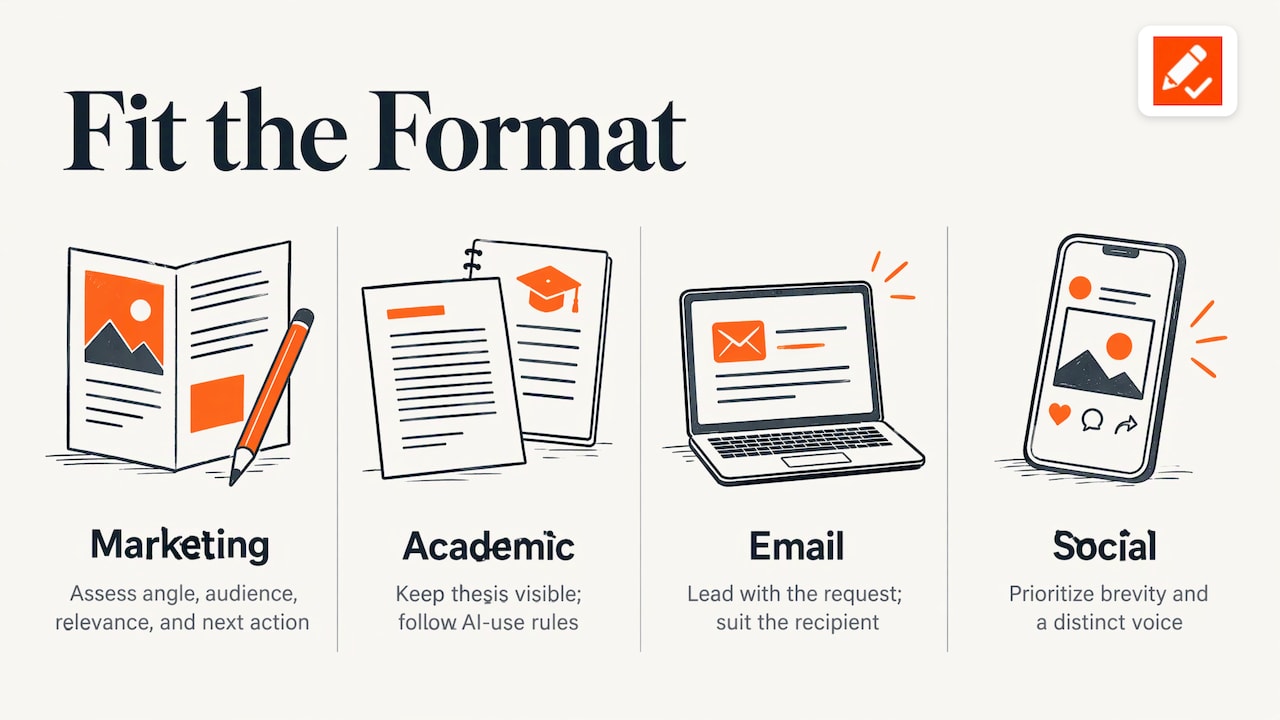
Marketing copy. Gynn recommends strategic editing before line editing: assess the angle, specificity, audience experience, relevance and the next action the content should prompt. Ask whether a reader at the right experience level would understand it, and whether they would know what to do next. Our pages on humanizing digital marketing copy, email marketing, SEO articles and website content go through each format.
Essays and research papers. Keep your thesis visible, keep the evidence yours, and follow your institution’s rules on AI use. The APA notes that its journals require disclosure and citation of AI use, do not allow AI as a coauthor, and leave accuracy with the author, according to its April 2026 article on academic writing. Course rules vary, so read your syllabus. See what is allowed in academic writing and how to humanize AI content for a research paper without losing academic quality. For essay-specific work, there is a dedicated essay humanizer.
Emails and professional messages. Shorter is better. Lead with the request, cut the pleasantries the model added, and make sure the tone suits the recipient.
Social posts. Brevity and a distinct voice matter most. The X posts and threads page shows how to keep short-form text natural.
Step 6: Read it aloud and refine
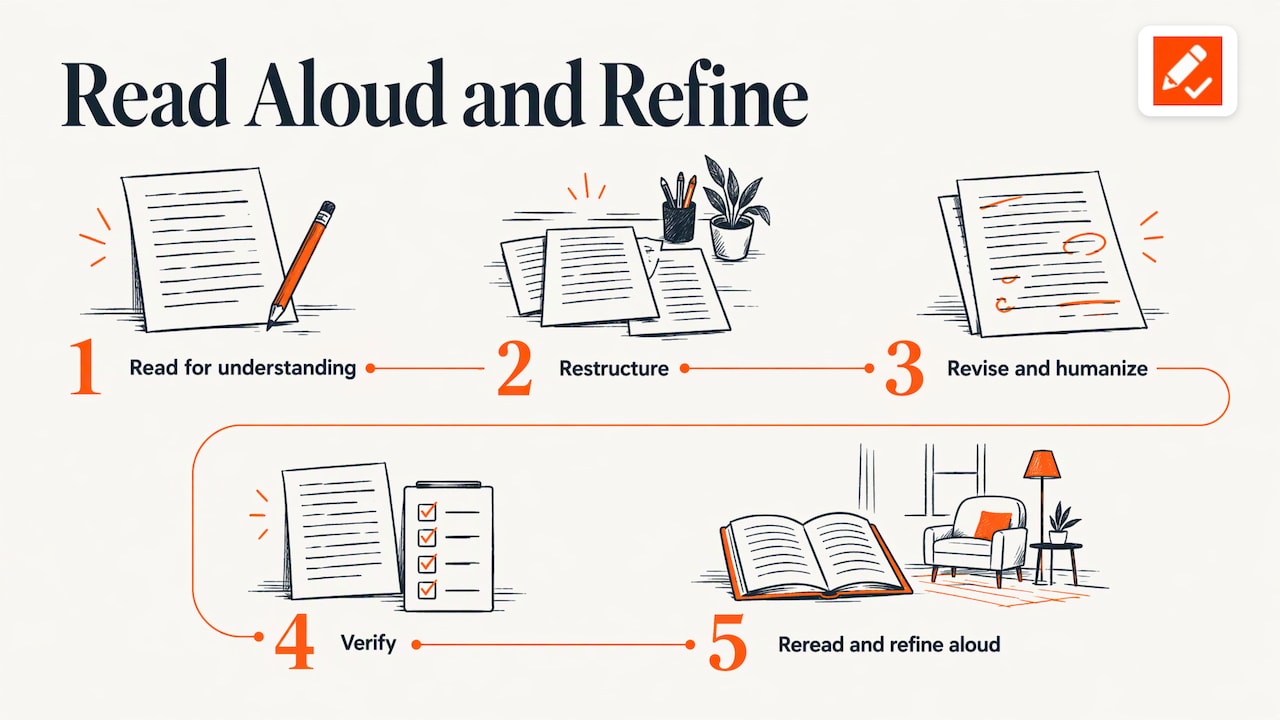
The last check costs nothing. The Oklahoma guide recommends reading the text aloud to catch mistakes and awkward writing, and lists what to listen for: stumbling, sentences that leave you short of breath, repeated words, shifts in tone and unclear passages. It frames the whole edit as five stages: read for understanding, restructure, revise and humanize, verify, then reread and refine aloud.
Mark every spot where you stumble and rewrite it in the way you would say it to a colleague. If a sentence sounds like nobody you know, it needs another pass.
A worked example
Take this typical AI sentence from a blog draft:
Moreover, it is important to note that effective time management is a crucial skill that can significantly enhance productivity in various aspects of professional life.
Problems: a stock connector, a throat-clearing phrase, two vague intensifiers, and no specific information. After a structural read you decide the paragraph should make one point: scheduling your hardest task first protects your best hours. After the sentence pass, it might read:
Schedule your hardest task for the first two hours of the day. That is when most people have the most focus, and the rest of the schedule bends around it.
The meaning is narrower and sharper, the rhythm varies, and the required keyword, time management, can still appear naturally in the paragraph around it. If you used a tool for the rewrite, this is the comparison you make against the original: same point, clearer shape, keywords kept.
Where Humanio fits
The six steps above are the whole routine. Steps 1, 2 and 4 are judgment calls only you can make. Steps 3 and 5 are the heavy lifting, and Humanio is made for them: it rewrites AI-generated drafts so they read more naturally, reducing repetition and improving sentence flow, with editing intensity you control. Marketers, bloggers, students, professionals and freelancers use it on articles, essays, emails and web copy.
Plans are Starter at $6.99 per week, Pro at $9.99 per week and Business at $19.99 per week, all on the pricing page. Humanio has also been tested with popular AI detectors including GPTZero, ZeroGPT and Pangram, though results vary with the text and the detector. For background on what detectors look at, read how AI content is detected, and you can run a draft through the Humanio AI Detector.

Paste a draft into the Humanio AI Humanizer, choose a light edit or a deeper rewrite, and then finish with your read-aloud pass.
FAQ
How long should polishing an AI draft take?
Plan on the structural read and fact check taking longer than the sentence pass, since those need your judgment. A sentence-level rewrite with a tool is fast; the time goes into comparing the result with your original and adding your own examples.
Should I use a tool or edit by hand?
Use both. Decide the structure and verify facts yourself, then hand the sentence-level work to Humanio to reduce repetition and improve flow, and finish by reading aloud. That keeps your judgment where it matters and saves time on the repetitive part.
How do I clean up AI text without changing what it says?
Write down the main claim, the examples and the required keywords before you start. After editing, compare the new version with the original and accept only changes that keep the meaning. Humanio is designed to preserve meaning and keywords, which makes this check quick.
Do I need to disclose that I used AI?
That depends on where the text goes. The APA says its journals require disclosure and citation of AI use, and universities and employers set their own rules. Check the policy for your course, publication or workplace before you submit.
Sources
- Making AI Writing Sound (Almost) Human, Oklahoma CareerTech
- Evaluating AI, Johns Hopkins University Libraries
- Using Text-Generating Artificial Intelligence, University of Waterloo Writing and Communication Centre
- Using Generative AIs for Writing with Less Risk, Cornell ELSO
- Professional Writing, U.S. Army CGSC Writing Guide, June 2024
- Good Editing Makes AI Content Memorable, Content Marketing Institute
- Examining the Capabilities of GPT-4 to Write an APA-Style Paper, Springer
- The promise and perils of using AI for research and writing, APA
- Teaching academic writing in the age of AI, APA Monitor